Tom
Bird BoxTom is a practical leader in the Riverbridge safe house, but his authority rests less on command than on the risks he accepts and the care he extends to others. He is the first person Malorie meets after the house debates whether to admit her: wary of what might follow an outsider through the door, he explains the precautions, then makes room for her. His history as a bereaved father gives that welcome particular weight. He understands that survival is not only a matter of keeping danger outside; it is also a matter of choosing whom the household will continue to protect.
Identity and First Encounter
When Malorie arrives, the household’s decision is uncertain. She calls through the closed entrance that she has kept her eyes shut and found the refuge through a newspaper advertisement. After the residents debate, a man tells her to keep her eyes closed until the door opens and to come inside quickly. Tom then introduces himself in a foyer occupied by five people standing shoulder to shoulder. He wears a makeshift helmet, with cotton balls and tape covering his arms and sharp objects projecting from them; two others hold broomsticks. The improvised defenses make visible the danger the residents believe an open door could admit.
Tom explains the caution rather than treating it as an insult: anything could slip in with Malorie. She answers that she understands. His explanation establishes a pattern in his leadership: fear is real, but it has to be translated into procedures that let people live together. He does not ask Malorie to trust blindly; he tells her why the household acts as it does, while still allowing her across the threshold.
Grief, Fatherhood, and Robin
Tom tells Malorie that Robin’s mother died in childbirth. He remembers Robin as an unusually perceptive child, attentive to details other people might overlook: the instructions for a toy rather than the toy, a film’s credits rather than its spectacle, the way something was written, or an expression on his face. Her description of her father as resembling the moon, not the sun, gives his recollection an intimacy that contrasts with the impersonal rules of the crisis. His grief is not an abstract backstory; it shapes how he sees the children and the risks facing them.
Before the catastrophe became impossible to ignore, Tom tried to continue daily life and not teach Robin to live in fear. As a teacher and a father, he initially hoped the reports would not dictate their lives. That effort ended as parents withdrew children from school and the school closed, while his own school also shut its doors. He remembers the resulting time at home as a chance to watch Robin grow, even as he sometimes changed the news channel because he could not bear to expose her to every frightening report. The account reveals both his protective instinct and its limits: he wanted to shield Robin without hiding the world from her, a balance the disaster would make increasingly difficult.
Leadership and Shared Survival
Tom’s leadership takes the form of planning amid uncertainty. Malorie notices that he has been distant and absorbed in thought before he gathers the housemates in the living room and announces that he has a plan. The evidence does not specify its details at that moment, but the scene shows him bringing private deliberation into a shared decision rather than acting alone. His role is not simply to supply answers; he organizes the household around the possibility of action.
That practical judgment also appears in discussions of water. When Felix asks whether they can drink from the river, Don points to bacteria, while Tom answers that safety depends on conditions including the water’s temperature, depth, and speed of flow. Jules adds that anything contaminating the well may also have reached the river. Tom’s response is cautious rather than reassuring: it treats the environment as variable and demands attention to particulars, even when no option can be declared wholly safe.
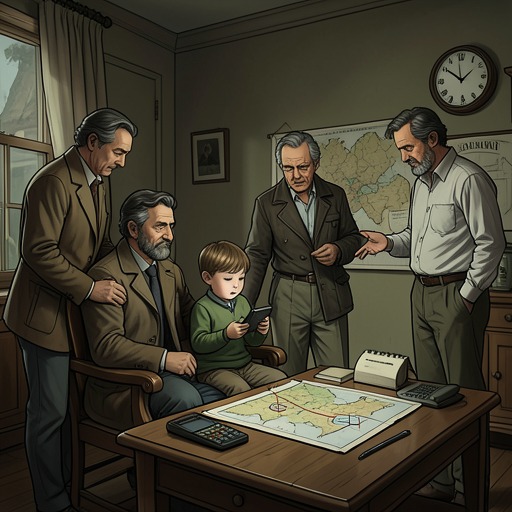
The household’s decisions are not always settled by his preference. When Gary waits outside for an answer about being admitted, Tom apologizes that the residents are still discussing it, then turns to the group and calls for a vote. The exchange places him at the hinge between an individual seeking shelter and a community weighing the danger of accepting him. Later, when Malorie says Gary can no longer remain, Tom and Don read the notebook Gary has brought; the evidence records their attention to it but does not establish that Tom’s reading resolves the dispute. The final decision belongs to the house, and Tom quietly agrees to lend Gary one of his helmets as he leaves. His conduct suggests that enforcing a boundary need not erase a person’s claim to dignity.
Risk, Protection, and the Children
Tom’s concern for others is tested outside the safe house as well as within it. During an expedition with Jules, the two men find a locked side door to a garage after a dog appears interested in something alive inside. The single window is covered with cardboard. Jules breaks it and proposes going in; Tom says he will go too. They tie the dog to a gutter and crawl through the window together. Something growls once they are inside, and the evidence cuts off as Tom turns back toward the window and Jules calls out. The scene shows Tom sharing danger rather than sending Jules to face it alone, though it does not establish the encounter’s outcome.
His attachment to the children is bound to his memory of Robin. When Jules finds a dog, Tom hears a boy call for help and hesitates: the father in him does not want to leave the child, and Robin lies buried behind the house he left long ago. He turns toward the master bedroom and says he would have come sooner if he had known the boy was there, then rushes to the stairs. The moment makes his divided attention explicit. The expedition has an objective, but a child’s need reawakens the loss that has shaped his life since Robin’s death.
Tom’s protectiveness also informs the household’s response to Malorie’s pregnancy and the children’s upbringing. Near the end of Malorie’s river journey, the Boy tells her that his blindfold no longer hurts. She orders him not to speak unless he hears something, while listening to him breathe in front of her and the Girl handle puzzle pieces behind her in the rowboat. The children remain under blindfolds, and Malorie hopes they may reach a world in which they can see what they have never seen. Tom is not present in this scene, but the children’s survival belongs to the protective household and future for which he worked.
Death and the Continuing Voice
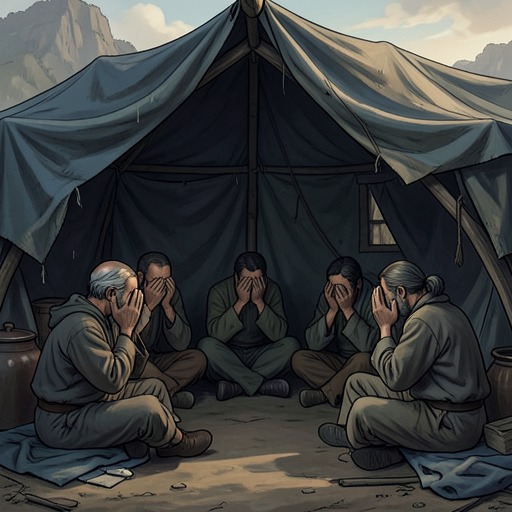
At the Riverbridge house, Tom’s importance outlasts his physical presence in two different forms: his body remains in the house, and his voice reaches Malorie years later. During her labor, she keeps her eyes tightly shut and plans to rehang the blankets, close the doors, and search every part of the house with a broomstick before opening her eyes. In the dark, she steps back through the living room and nudges what she believes is a bag of sugar. It is Tom’s body. She does not recognize him, and the evidence does not identify how he died. The ordinary, misidentified object captures the separation between the labor of bringing children into the world and the death that has occurred nearby, unseen.
Much later, on the river, the Boy repeats a recorded message: “Riverbridge,” he says. “Two seventy-three Shillingham. My name is Tom.” The words identify the destination and the speaker, making Tom’s voice a guide for Malorie and the children even though he can no longer lead them in person. The name he gives is also the name Malorie has chosen for her son. That echo connects the dead man who helped shelter her to the child she is bringing toward safety, without making them the same person: one is the household’s lost protector; the other is the future Malorie is trying to preserve.
Narrative Role and Significance
Tom links the novel’s domestic and survival strands. The improvised armor in the foyer, the household’s debate over newcomers, the cautious assessment of river water, and the dangerous search for a dog all show a community trying to turn fear into workable decisions. Tom is central to that effort because he combines procedural caution with personal attachment: he explains why a stranger must be inspected, calls for a vote rather than deciding Gary’s admission alone, and risks entering the garage alongside Jules.
His story is also shaped by repeated losses and acts of care. Robin’s death remains present whenever Tom encounters a child in danger; his recollection of her makes his response to the boy’s call more than an abstract duty. His own death is not recognized when it occurs, but the recording of his name and the shelter’s location carries his presence forward. In the novel’s world, where sight can be fatal and routes must be learned through sound, Tom’s voice becomes a practical inheritance: an address, a name, and a direction toward a place where the living may continue.